
 UK
UK
 EU
EU
 US
US
Article: How Much Protein Do You Need Per Day to Build Muscle?

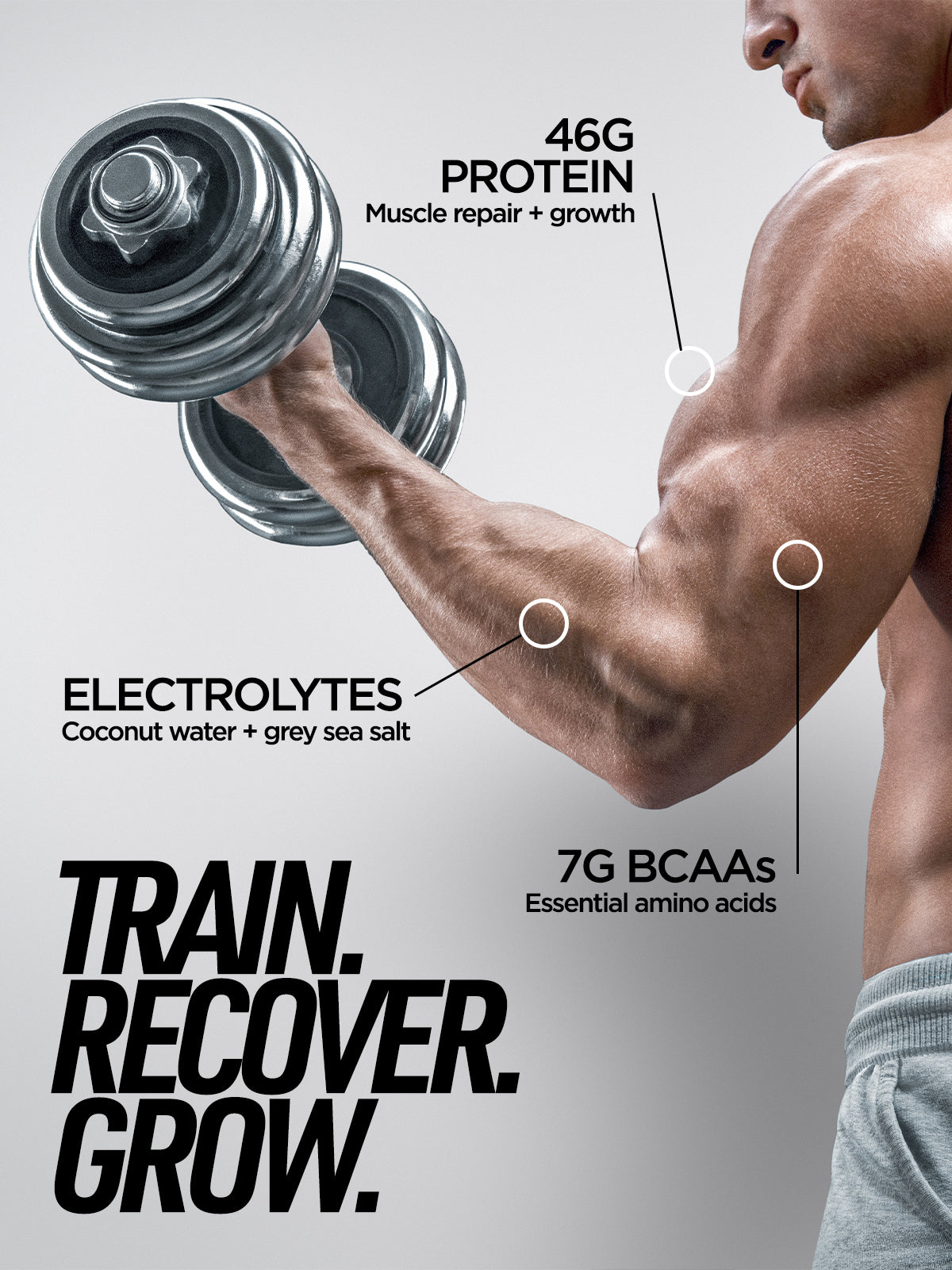
How Much Protein Do You Need Per Day to Build Muscle?
For many healthy adults who regularly undertake resistance training, approximately 1.4–2.0 grams of protein per kilogram of body weight per day is a useful general range for supporting muscle growth and maintenance.
For example, someone weighing 80 kg might aim for approximately 112–160 g of protein daily, including protein from both food and supplements.
Your ideal intake depends on your body weight, training programme, calorie intake and individual circumstances.
In this guide, we'll explain how to calculate your protein needs, how to distribute protein throughout the day and how whey or plant-based protein supplements can help.
How Much Protein Do You Need to Build Muscle?
Protein contributes to the growth and maintenance of muscle mass.
Resistance training provides the stimulus for muscle development, while adequate protein supplies the amino acids needed for muscle repair and adaptation.
For many healthy adults undertaking regular strength training, a practical starting range is 1.4–2.0 g of protein per kilogram of body weight daily.
Research suggests that benefits for muscle growth tend to level off around 1.6 g/kg/day on average, although individual requirements and responses vary.
Higher intakes are not automatically more effective, and training quality, total energy intake and recovery remain important.
Daily Protein Calculator: How Much Do You Need?
You can estimate your daily protein target using this formula:
Body weight in kilograms × 1.4–2.0 = grams of protein per day
For example:
80 kg × 1.4 = 112 g
80 kg × 2.0 = 160 g
This gives an illustrative daily target of 112–160 g.
Protein Requirements by Body Weight
| Body weight | 1.4 g/kg/day | 1.6 g/kg/day | 2.0 g/kg/day |
|---|---|---|---|
| 50 kg | 70 g | 80 g | 100 g |
| 60 kg | 84 g | 96 g | 120 g |
| 70 kg | 98 g | 112 g | 140 g |
| 80 kg | 112 g | 128 g | 160 g |
| 90 kg | 126 g | 144 g | 180 g |
| 100 kg | 140 g | 160 g | 200 g |
| 110 kg | 154 g | 176 g | 220 g |
| 120 kg | 168 g | 192 g | 240 g |
These figures are illustrative targets for healthy, active adults, not universal recommendations. For people with a high proportion of body fat, using goal weight or an individually assessed target may be more appropriate than calculating from current body weight alone.
Is 1.6 g of Protein per Kilogram Enough to Build Muscle?
For many people, 1.6 g/kg/day is a reasonable target.
Research examining resistance training and protein intake suggests that muscle-building benefits often approach a plateau around this level on average.
However, the ideal intake varies with training experience, energy balance, age and individual responses.
Some people may choose an intake closer to 2.0 g/kg/day, particularly when trying to maintain muscle during a calorie deficit.
Consuming more protein than needed does not guarantee additional muscle growth.
How Much Protein Should You Eat Per Meal?
Distributing protein across several meals can be a practical way to reach your daily target.
Many healthy adults who train regularly use approximately 20–40 g of protein per meal, although larger individuals may benefit from larger servings.
For example, someone targeting 140 g daily might consume:
| Meal | Protein |
|---|---|
| Breakfast | 30 g |
| Lunch | 35 g |
| Afternoon snack or shake | 30 g |
| Dinner | 45 g |
| Daily total | 140 g |
These amounts are examples, not strict limits.
Your body can digest and use protein from meals containing more than 40 g. There is no universal rule that protein above a particular amount is wasted.
Do You Need More Protein When Losing Weight?
When losing weight, adequate protein intake becomes especially important for maintaining muscle mass.
A calorie deficit can make it more difficult to preserve muscle, particularly if resistance training is reduced or dietary protein is inadequate.
For many healthy adults, consuming sufficient protein within a calorie-controlled diet and continuing resistance training can help support muscle maintenance.
Some lean, highly trained individuals undergoing aggressive calorie restriction may have higher protein requirements than the general exercise range.
However, more protein does not automatically mean faster fat loss.
Protein powder itself does not burn body fat. Sustainable weight loss depends primarily on energy balance.
Read our Best Protein Powder for Weight Loss guide.
Is Whey Protein Better Than Vegan Protein for Meeting Your Daily Target?
Both whey and plant-based protein can contribute to your daily protein intake.
Whey is a complete protein source naturally rich in essential amino acids, including leucine.
Plant proteins vary in amino acid composition and digestibility. Suitable blends, varied food sources and sufficient total intake can support muscle growth and maintenance.
Whey and plant-based proteins are not necessarily identical gram for gram in every situation, but both can be useful choices.
Explore:
Do You Need Protein Powder to Reach Your Daily Protein Target?
No. You can meet your protein requirements through a balanced diet containing protein-rich foods.
However, protein powder can be convenient when you need additional protein without preparing another meal.
For example, if your daily target is 140 g and your meals provide 115 g, a protein shake supplying approximately 25 g would help close the gap.
Check the nutrition label because protein content and serving sizes differ between products.
Raw Sport Protein Options
Grass Fed Whey Protein Pro
Raw Sport Grass Fed Whey Protein Pro is an option for customers who prefer dairy-based protein to help meet their daily intake.
Elite Repair Plant-Based Protein
Raw Sport Elite Repair Plant-Based Protein is an option for customers who prefer plant-based nutrition.
Diet Protein Low Carb
Raw Sport Diet Protein Low Carb may suit customers prioritising protein relative to calories.
Diet Meal Protein
Raw Sport Diet Meal Protein provides another option for customers who prefer a more substantial shake containing oats and fibre.
The right choice depends on your nutritional goals, dietary preferences, allergens and calorie requirements.
When Is the Best Time to Take Protein for Muscle Growth?
For most people, total daily protein intake is more important than consuming protein within a narrow post-workout window.
You can consume protein before training, after training or at another convenient time.
Spreading protein-containing meals throughout the day is a practical approach.
If you struggle to reach your protein target through food alone, a protein shake can help.
Do Women Need Less Protein Than Men?
Not necessarily when protein requirements are expressed relative to body weight.
Women and men both require adequate protein for muscle growth and maintenance.
Differences in total daily protein needs often reflect differences in body size, training and individual circumstances rather than a need for gender-specific protein powder.
Read: Best Protein Powder for Women.
Frequently Asked Questions
Is 100 g of protein enough to build muscle?
It may be enough for some people, depending on their body weight and training. For example, 100 g represents approximately 1.67 g/kg for a 60 kg adult, but only 1.0 g/kg for a 100 kg adult.
Is 200 g of protein per day too much?
That depends on body weight, activity, health and total diet. It may be appropriate for some larger or highly active individuals but unnecessary for others. People with kidney disease or other relevant medical conditions should obtain individual medical advice.
Can you build muscle with 1.2 g of protein per kilogram?
Yes, muscle growth may still occur, especially in beginners. However, higher protein intakes can provide additional benefits for some people undertaking resistance training.
Does eating more protein make muscles grow faster?
Not indefinitely. Adequate protein supports muscle growth, but consuming more beyond your requirements does not guarantee additional results.
Does protein from food count the same as protein shakes?
Both contribute to total daily protein intake. Protein sources vary in digestibility and amino acid composition, while whole foods also provide other valuable nutrients.
Final Verdict: How Much Protein Should You Eat?
For many healthy adults who train regularly, approximately 1.4–2.0 g of protein per kilogram of body weight daily is a practical general range.
Start with your body weight, consider your training and dietary goals, and aim to meet your protein requirements consistently.
Remember that resistance training, adequate calorie intake, recovery and sleep are essential parts of muscle development.
Protein powders are simply a convenient way to help fill the gap between the protein you obtain from food and the amount you need.
Explore Raw Sport protein options:
Related reading:
Leave a comment
This site is protected by hCaptcha and the hCaptcha Privacy Policy and Terms of Service apply.